My fascination with Punta Begoña and the figure goes back to long before the collaboration proposal, so my involvement felt very natural.
We are sharing the recent interview with Diego Sologuren, author of the Ex Luce intervention at Punta Begoña, as part of the OPEN BILBAO 2025 Festival.
Architectural heritage should be valued, restored and returned to the city to encourage its use. That is architecture’s contemporary challenge.
> Your professional experience has taken place in several countries, such as Belgium, France, Germany and Switzerland. In recent years you have been living in Euskadi again. What differences do you find in the way architecture and monuments are understood and experienced?
Although at a global level there is a general tendency towards homogenisation and towards reducing architecture to a mere market product, in some places resistance to these dynamics is palpable thanks to a tradition of architectural and design culture that sustains it. Among other initiatives, they have education and outreach policies with a long track record, because they understand this as a guarantee of a better and fairer life in cities and among people. In Euskadi, valuable efforts are being made by public bodies to bring it closer to the public; however, market dynamics here are particularly fierce. There has been a substantial loss of heritage, especially industrial heritage, in favour of the ruthless drive of the construction sector. Every new urban and real-estate development we see is a missed opportunity to build a higher-quality city.
> You have even worked with the 2022 Pritzker Prize-winning architect, Burkina Faso’s Diébédo Francis Kéré. What do we still have to learn about economics, resource use and dialogue with the landscape?
Collaborating with Francis Kéré and his on-the-ground teams put me in touch with a way of working that means designing with an economy of means, offering a capacity for rapid response and, above all, requires a willingness to consciously assess and reposition oneself constantly in the face of the cultural codes of contexts very different from our own. In the kind of social projects I was involved in, both in Burkina Faso and in other African countries, taking part entails direct contact with communities. They get involved collectively with pride and excitement, understanding the common good as an opportunity for development. There is a great deal of enthusiasm to move forward with dignity. Unity and hope—that is the lesson. The landscape is another chapter. Although Kéré conceives building as a reinterpretation of traditional know-how, combined with the incorporation of ingenious bioclimatic solutions, the environments in which they are set are far from easy.

> Your work could be described as conceptual. And yet it is also able to connect with people’s emotions. What are you looking for when you take on each project?
I work from intuition, with a desire to push architecture towards the open framework that art offers. In my work there is a subversion of typological models, a shift of meanings, a juxtaposition of scale and a misalignment of cultural conventions that makes each piece be perceived as a kind of unexpected moment, easily understandable to anyone, operating somewhere between the absurd and the poetic. In addition, as in any architectural work, my projects are born from the context in which they are placed and are offered to the public to be experienced in real time, to be touched and lived: they are not meant to be autonomous objects with a purely symbolic dimension. The interventions are not discourses, but rather situations with their own narratives that, by virtue of being architecture, tend to connect with people and be appropriated by them. On another level, the compilation of these installations fits within a conceptual framework with a critical and transformative vocation.
> Much of your work focuses on the dissemination of architecture. You have carried out projects for the Lisbon Architecture Triennale, the Tbilisi Architecture Biennial or the TAW in Tirana. What did you think when you received the call from the OPEN Festival of architecture and urbanism, so close to home?
It is especially stimulating to have been able to take part in a project at home and, above all, in a place as iconic as Punta Begoña. My fascination with the site and the figure goes back to long before the collaboration proposal, so my involvement felt very natural. Needless to say, it is an honour for me to be able to contribute to the dissemination of architectural culture through local initiatives. I hope this sets a precedent, encouraging other institutions to carry out more interventions of this kind and, why not, to keep them as well.
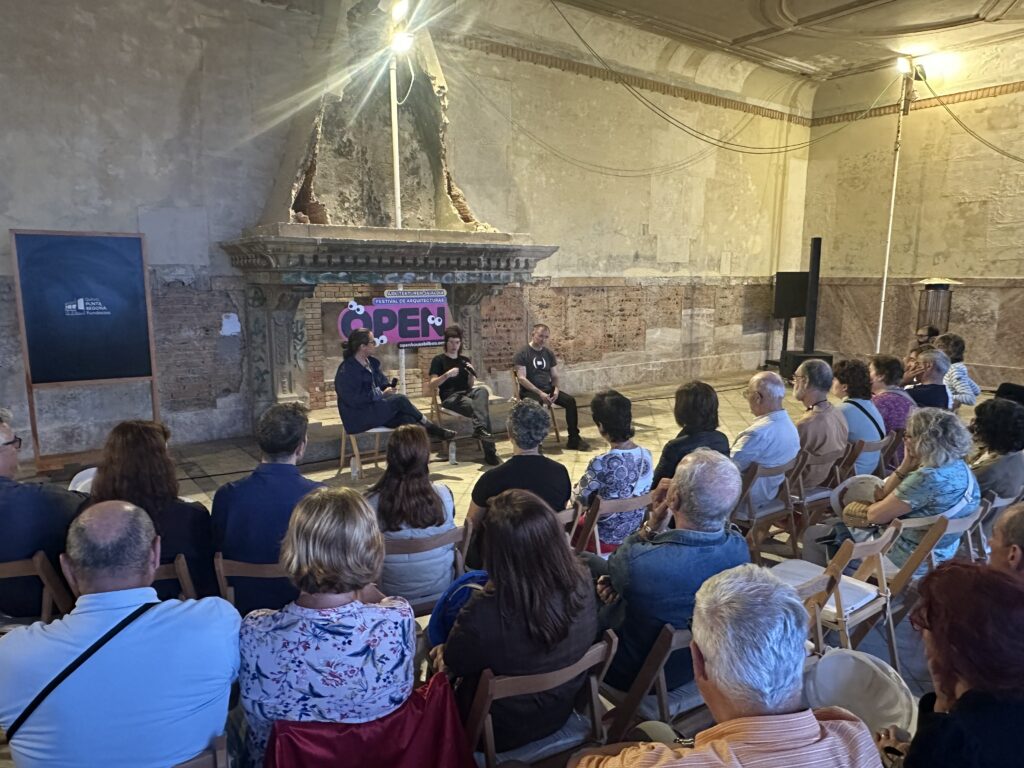
> Could you tell us what the process of shaping the Ex Luce piece for Punta Begoña was like?
The intervention I was asked to propose was not initially conceived—either in terms of resources or logistics—to be as it eventually was. The organisers imagined something on a smaller scale and with a simpler technical set-up. When the concept was presented, the proposal was well received and support was immediate. For my part, the idea and the link to the anecdote of switching on the light were an initial hunch that remained. The process of conceiving the action, sourcing the material and then coordinating the build and installation was complex and, for me, brought a certain wear and tear. I think that, if not for my ability to understand and persist through processes as an architect—coordination of trades, contacts with companies, communication—I would have abandoned the project. After back and forth, refusals from suppliers, surprises and unexpected last-minute support, the object was installed. It turned out exactly as planned and, for me, it more than makes up for everything that came before.
> From your perspective as a professor at the IED Kunsthal Bilbao Higher Centre of Design, what future do you think historic places like the galleries have for engaging in dialogue with the contemporary, compared to other newly built spaces and “white walls”?
Let us assume historic places as living places. In them, stories, testimonies and memories overlap, and they cannot be sidelined or museumified as something static and alien. . The IED Kunsthal building itself, on the Deusto riverbank, is a former factory that has been adapted to a new use. I believe that there is enough architectural heritage that should be valued, restored and returned to the city to enable those uses. That is architecture’s contemporary challenge. . New construction and “white walls” belong to another time.